Category: Book reviews

Anna Gavalda’s French Leave: Childhood’s very final (and very fun) hurrah

Anna Gavalda’s French Leave: Childhood’s very final (and very fun) hurrah

Some families are enviably idyllic. They traverse, like great big sail ships of old, through azure treachery of life’s turbulent waters, and no Pacific mega-storm or some ghastly kraken could break up the merriment on deck.

Gavalda gives us such a family in her 2011 novel French Leave. Four siblings, four nodes of a single pulsating system, each with their own prosaic cross to bear as they go forth adulting in life. And yet, in spite of the distance and the in-laws and the brutality of comfortable middle-class ignorance, these siblings, these saplings of a very cherishing earth, keep the gentle strings that maintain the delicate ecosystem of their connection in perfect balance.

They find their sanctuary, this joyful quartet, in a picturesque French countryside, with a chateau, wine, and music, an endless mixtape of carefully curated gems, each a token from not-so-distant past, the before-parents-divorced past, the before-the-gadgets past, complete with outdoor fun and scraped knees and crazy fun games. This is a lovely eulogy to Childhood, a sacrosanct interval on life’s measuring tape, and no amount of fussy sisters-in-law can commandeer it.

We don’t always burst with love for our siblings, but if we do it probably should be done like Gavalda’s four witty thirtysomethings. How do adults retain that level of effortless panache? That perfectly executed series of witty repartee? That intuitive, worldless understanding of the other heart’s rhythm? Is this even normal? Is this even real? Maybe distance, geographic and temporal, jump-starts the soul to its optimal performance level? How’s this, from the mouth of the youngest sibling (and our narrator):

“A huge wave of tenderness washed over me looking at the three of them: somehow this felt like the last magic show, the last birthday party of our childhood…

For almost thirty years they’d been making my life a place of beauty. What would I become without them? When would life decide it was time for us to part?

For that’s the way it goes. For time parts those who love one another, and nothing lasts.”

A gentle, silver-webbed kind of melancholy pierces this moment of universal experience. Who are we without our dear ones, those chance witnesses of our brief pilgrimage through life with all those monotone photocopier struggles and grocery store runs and weddings and divorces and the occasional sneaky cigarette. They liberate us, our dear ones, just as Adulthood pins us, like butterflies, to its collection board.

“For how much longer will we have the strength to tear ourselves away from everyday life and resist? How often will life give us the chance to play hooky? When will we lose one another, and in what way will the ties be stretched beyond repair? How much longer until we become too old?”

In the world of this novel, the happy recess from Adulthood comes to an end, waving goodbye to old castles and cassette tapes. This is all too neat, too careful, like a polite curtsy at the end of some country dance. For what would happen if this amusing recess were to turn into a whole lot of skipped classes for the rest of the afternoon..? Pearls never lie on the seashore.

Frederic Beigbeder and the decadent ennui of the upper-middle

Frederic Beigbeder and the decadent ennui of the upper-middle

Time cynically melts us all into oatmeal-variety curmudgeons… When I first familiarized myself with Beigbeder’s eloquent prose I was but a wee lass, deep in the throes of undergraduate know-thyselfing. A French Novel and Windows on the World had enthralled me by their world of nonchalant elegance and existential masturbation, carried on the sleek back of comfortably high Parisian incomes. Wide-eyed working-class Cinderellas always long to hatch into twenty-first-century Marie Antoinettes, toying with theatrical suicides as they soak up boredom and prosecco in a bath filled with diamonds and euros.

That was then and this is now. Beigbeder’s world still ravishes the reader’s senses, but whether it’s due to the throbbing waves of geopolitical metamorphosis, or merely due to something as banal as aging, my awe over his characters has withered into a very maternal sort of pity with a pinch of proletarian disgust.

Beigbederian hero, who is he? Young. Wealthy. Smart. Addicted to drugs, alcohol, sex, and partying. Adorably self-aware, self-hating and, to complete the initial data set, hopelessly narcissistic. He is a contemporary Nero longing for a return to childlike innocence as he parties his way toward a spiritual grave, wilfully mistaking its high-octane throbbing for the cavernous warmth of a womb. In Holiday in a Coma and Love Lasts Three Years, the hero is Marc Maronnier, a beautifully vapid butterfly, sadder than “a saucepan of milk boiling over,” a writer with a democratic libido (“some girls are so bovine they make you feel like a country vet…but I have to keep going”), and an eager documentarian of Parisian party scene with self-awareness of his privilege gnawing at him like an ulcer:

“Never has he been more forcefully aware of his standing as a snot-nosed brat from a good family than now, as he shakes his thang across the white marble floor, dreaming of being a rebel when in fact he is one of the landed gentry, alone in the midst of a herd of jaded ravers with no valid excuse while millions of the homeless sleep on scraps of torn cardboard when it’s -15 outside. He knows all of these things, which is why he hangs his head.” 

This is before the gilets jaunes and even before the Occupy movement, yet one can already smell the gunpowder of class friction, a scent far more potent than others emanating from Parisian nightclub loos Marc frequents (to amplify the metaphor, the nightclub in question is called Shit and is actually shaped like a massive toilet bowl). It is a miasma of glorious decay of Western masculinity, of euro-optimism, of bourgeois smugness, of cosmopolitan decadence. Like a Salvador Dali painting, the contours of past virtues are irreparably skewed. This is Peak Chaos, an infernal cauldron in which all these people with very classically First World problems simmer into a delectably poisonous stew.

And yet, it’s always most dark before dawn, isn’t it? Cynic he may be, but our privileged hero leaves us with the following axiom: “The most wonderful thing about life is that it goes on.” A couple hundred pages of entertaining mental masochism kamikaze themselves into a rather normal, even optimistic, finale. I’m not buying it though. By my reckoning, every Beigbeder ages into an Houllebecq, and there’s no stopping it.

Image: A Man Staring by Egon Schiele.

Eric-Emmanuel Schmitt: Moral fables for the difficult world

Eric-Emmanuel Schmitt: Moral fables for the difficult world

Why would someone bequeathe their entire fortune to an absolute stranger? Why would someone keep on buying a dog of the same breed and call them the same name, over fifty years’ span, only to end their life a day after the unfortunate canine gets fatally hit by a car? Why would a husband swell with obsessive veneration of his wife’s ex, to the point of insisting that she re-take her former spouse’s surname? Why would a couple suddenly fall out of love upon getting rescued from a snowy cave by a young girl with cystic fibrosis? Random questions, mystical answers, elegant plot twists, and an obligatory moral lesson – all this neatly packaged in four short stories gathered under the kind of title glancing upon which could surely elicit a number of fatigued eye rolls from early-morning subway commuters. Invisible Love.

From a title like this one expects something saccharine, something romantic and sufficiently sentimental. And yes, there’s plenty of nostalgically wistful moments in this Franco-Belgian prose that make one sigh and recollect tender childhood moments of hot cacao on Sunday mornings. Yet Eric-Emmanuel Schmitt, with his numerous European literary regalia, does his readership one better and, in four tales of mystery, fantasy, and romance, paints relatable revelations about human character, each wrapped into a poignant moral parable.

The first tale, Two Gentlemen from Brussels, is about the evolution of marriage in the microcosm  of two very different families whose trajectories were brought together through sheer coincidence. They both got married on the same day, in the same church, except one couple enjoyed the hefty benefit of state, ecclesiatic, and societal recognition, while the other, consisting of two men, had to cherish their love in secret and to whisper their modest “I do’s” in a delicate echo to the first couple’s loud proclamations. Two families secretly bound, two vasty contrasting fortunes, and yet, in Life’s insufferably sarcastic snark, both come to roughly the same educational conclusions as their journeys approach that final sunset. Loving is difficult and sometimes destructive, yet we march on, like tired soldiers under a weathered banner, for better or worse, for richer or poorer…

The second tale, The Dog, is just sad. A man and his dog, a symbiosis to which multiple praises were sung over the centuries. A Nazi concentration camp survivor and his only friend, his canine friend, emerge as epitomes of endurance and devotion. They persevere, like spring’s first flowers, through food shortages, violence, and even in death, inspiring those they left behind to go on living and loving, drinking good whisky and hurriedly making love.

Ménage a Trois, aptly, comes third and tells of a frustrated, impoverished widow in the last days of her bloom, earnestly endeavouring to gold-dig her way out of misery and into the upper-middle (at the very least) stratum. She procures a requisite specimen, a Danish diplomat, who propels her into precisely the kind of luxury she dreamt of. It’s perfect, except there’s one tiny little thing. The Dane is obsessed with her ex-husband, or rather his music, looking to publish it, to celebrate it, to commemorate the composer, to elevate the dead relation into the ranks of national heritage, pushing his new wife deeper into the throes of this macabre joke. We do find out who the composer is at the end of the story  – he’s really famous and really real, and suddenly the story makes excellent sense. The moral takeaway, nonetheless, is blatantly clear: you can never really bolt the door to your past, no matter how expertly you barricade it from unwelcome intruders.

Finally, The Ghost Child is as banal as it is psychologically acute. A success-studded model family and their never-healing, scarlet-red stigmata – a child, a hope of a child, a ghost of a child, a barren memory of a child. What happens when individuals used to perfection are suddenly  thrown into a throbbing cauldron of defective chaos imposed in a cruel dictum of chromosomes, genetic disorders, the whimsies of DNA? Can modelesque bodies, enviable careers, and vacations in the Alps overpower the terrible stench of doubt, disappointment, and loss? When all manner of puppet theatre becomes futile, how does one “keep calm and carry on”? Fate can have the snarkiest of humours, which is what our perfectionist characters discover, in a fairy uncomfortable experience. The lesson? No matter what decision you make, however educated, however reasoned, Life will always find a way to get the last laugh. Be prepared, if you can.

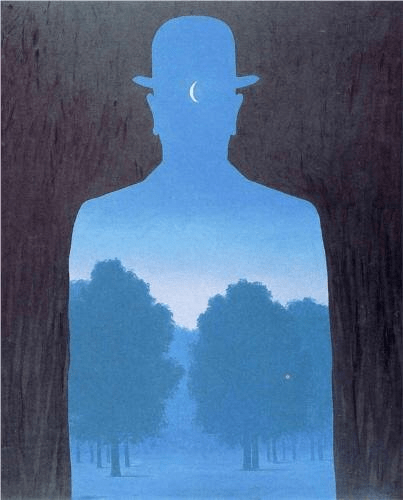
Image: Rene Magritte, A Friend of Order