Category: Literature

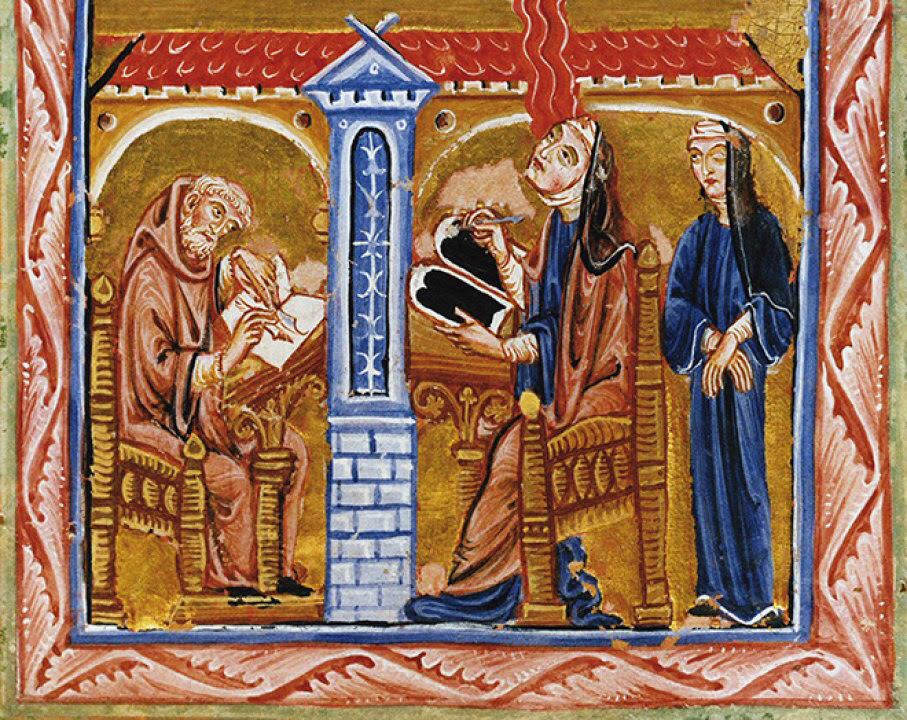
Hildegard Von Bingen: the hippy nun and her cosmic eggs

Hildegard Von Bingen: the hippy nun and her cosmic eggs

“I, the Living Light who illumines what is obscure, have placed the human being whom I have willed, and whom I have wonderfully afflicted as it pleased me, in the midsts of wonderful things, beyond the reach of human beings in the past, who did see in Me many hidden things; but I have laid her low on the ground, so that she may not set herself up in any boldness of mind.”

The above is from Von Bingen’s Scivias, her seminal work, a collection of her famous visions, a supreme theological work and a key to Hildegard’s 12th century superstardom. She was a woman of many talents, glorified and catalogued ad nauseam by theologians, literary critics, psychologists, historians, feminists, wellness practitioners, musicians, and even doctors. Yes, she touched upon all those multidisciplinary endeavours throughout her uncommonly long life span of 80 years, secluded comfortably in a monastery in Germany. She spent most of her life there, a fiery shepherdess to fifty odd nuns, apart from the time she spent on tour. Yes, she has speaking tours, impressing upon the clergy and the laity the phenomenal world of her visions. And what visions! Cosmic eggs, gigantic humanoids seated atop mountains, assorted animals writhing in apocalyptic tropes, and much more, hardly fit for this humble blog to list. And music, of course. Hildegard wrote absolutely ethereal music usually performed by a crystal-thin soprano to the accompaniment of other sopranos, an auditory splendour stemming from utterly original composition rules, each musical piece a holistic and self-sustained ecosystem, so different from the stale rigour of Antiphons and Responsories.

She did all these incredible things (even by our hyper-over-achiever standard measure), yet she wasn’t even classically trained in the contemporary trivium or Latin. That hasn’t stopped her from becoming a thought leader du jour and having bishops, emperors, and even the pope take note of her opinions on theology, politics, philosophy, and other critical matters.

Many odes can be sung to Hildegard, but what is truly remarkable in her work is the freshness, simplicity, and harmony in which she contextualizes her beliefs. Everything for her is steeped in greenness, veridity, fertility, growth, and bloom. Everything is natural and of God. There is little room for asceticism, self-denial, and piety. Instead, moderation, balance, and enjoyment are crowned as the very nexus of good life. Life itself is of interest to Hildegard, and not merely as a means to a glorious end surrounded by rosy-cheeked cherubs, but rather as a thing in of itself. She writes with equal joy about the End of Days as she does about the medicinal properties of gemstones or of putting a dead mouse into a bucket of water to heal epilepsy. Nothing is beyond her reach; everything is firmly and securely a sacred part of her world. At times, she sounds definitely New Agey, her life-affirming positivity resonating strongly with the type of philosophy that’s popular today in the West, bubbling in conversations over kombucha after a hot yoga class. This, in part, explains her enduring popularity in academia and beyond.

Modern neurological commentary explains Hildegard’s visions as an effect of her migraines as much of today’s discourse still wastes precious time debating whether her experiences were real or a hoax. Who cares. What’s infinitely more interesting is the love, divine and human, that permeates every sentence of her opus. And even as her metaphor of a cosmic egg foresees great troubles ahead as the end of time mirrors the sharp end of the egg, there is a kind of joyful acceptance of it all. Hildegard urges her audience not to worry themselves as much with what will be (hell, devils, bodies of sinners writhing in giant cauldrons) as with what is (the music of the firmament, the perpetual growing, breathing, pulsating Life).

Here endeth the lesson.

Therese Bohman: The Scandi Houllebecq

Therese Bohman: The Scandi Houllebecq

I read Bohman’s The Other Woman while being plied with pina coladas and strawberry margaritas on the azure beaches of Mayan Riviera. It was just the venue for such a literary pick. A doozie. A Candace Bushnell of the Nordics. Wrong. What was framed as “an intense affair” of a hospital dishwasher and a gallant, silver-haired, and married (naturally) doctor has turned out to be a somber lamentation on the figure of a Western Woman as she stands, weighted down by her own intellect and sexual freedom, at the agate-hued precipice, looking down with a mixture of masochistic excitement, guilt, fear, and submission. The main character, inhabiting, in a kind of a callous career experiment, the lowest ranks of hospital staff, is, essentially, “red-pilled” to the ruse of modernity, yet she seems to levitate far above it all, above the monotony of university cafe conversations and the delicate feminist boys and the independent ambitious girls and their tiresome, moralizing, self-aggrandizing tirades. Our unnamed heroine, armed with superb intellect and having read Dostoyevsky and Baudelaire, is pursuing an affair with a married superior, almost out of spite, almost as challenge to that last feminist taboo. After all, she argues with her more conventional friend, “I am a failure as a feminist woman. I am a failure as a perfectly ordinary woman as well, I am too clever. I have always felt like a traitor. I am a traitor in every camp because I don’t really need other people. That is the greatest betrayal of the sisterhoood, an awareness that you have no need for it.” Our girl breaks through the oppressive, suffocating comfort blanket of The Sisterhood. She does it with a piercing awareness of the inherent despair seeded within the human condition, so there is no silliness in her pursuits. No bubblegum romanticism. None of that. Only refreshingly deep thoughts, heavy like droplets of liquid mercury, delivered to the reader against the grey landscape of a remote Scandinavian town. Does she find happiness? Or meaning? Doubtful. Even in moments of peace there is a palpable sense of that agate-hued precipice, just over there, just a step or three forward. And that brings me to Houllebecq.

Houllebecq is the renowned (or “controversial,” to use Guardian-speak) French author of Submission, Atomized, and many other books featuring a depressed middle aged man grappling with sad realization of his own insignificance and bitter loneliness against the backdrop of the disgraceful decline of his once great civilization. Houllebecq’s characters find a reasonable amount of professional success, traditionally accompanied by excess of meaningless sex. There are solid attempts to find meaning in academia, in romantic love, even in religion, but to no avail. Houllebecq’s French men stare into the precipice of their own, nearing it with each cigarette smoker breath they take, submitting dejectedly, almost sheepishly, to their live’s sunsets. I read his works as a piercing allegory to the decline of Europe, and every time I visit Europe it feels like visiting a beautiful marble tombstone. A sarcophagus. Perhaps such lamentations are premature from a political, social or economic standpoint, but art, since the time of Greece, is best at the time of a civilization’s decline.

That last point (about art and Greece, not about the decline of Europe) is made in Bohman’s other book I read. This time it was on loan from the library, and swallowed by me over the course of one day. Eventide features characteristically reserved Stockholm landscape, an academic circle with all the correct political and cultural opinions, and an art professor dealing with a fresh divorce, professional competition, loneliness, and an apocalyptic dream-nightmare of Finnish ferries crashing into the city, bringing about the end to all presence that things are normal in society. The protagonist Karolina, much like any of Houllebecq’s men, is a woman in physiological decline living in a country also in decline, albeit hidden beneath the inspiring facade of social democracy and its assorted projects. Karolina has mastered the art of solitude, boosting its quality with homemade tomato sauce, ample social media use, and intense sexual encounters. But of course, she is deeply unhappy, navigating the world which hasn’t yet figured out what to do with 40-year old divorced women, pulling them out from one folder and into another, giving them hope one moment, and then smashing it to the ground the next. Karolina’s life is intertwined with that of an underrated Swedish artist of the early 20th century and that of an unknown Russian woman, the mysterious G., a willing womb donor in a fabled Soviet experiment to create a human-ape hybrid back in 1920s. All three of these narratives fail, fruitless, unsuccessful, and a grey dawn follows. Hollow and sorrowful, but a dawn nevertheless. And with dawn comes hope, however frail, however faint, however pale.

Bohman’s heroines traverse oceans of despair and meaninglessness, but they hold their ground with intellect and cool head. They show decent chances of survival, unlike Houllebecq’s men who are sentenced to very inglorious final acts, an embarrassing jig of loneliness, booze, sex, and failing organs. All of these delightfully melancholy books are, to me, very potent tokens of memento mori, the Christian practice of reflecting on mortality. It’s the veneration of all those skulls and bones in Western art with humble hope of serving as a somber reminder to look beyond the horizon, at least occasionally. Bohman and Houllebecq are dutifully putting up flaming beacons for precisely this sort of a reminder: when staring at the precipice let your eye swerve a wee bit over and beyond, if only for a whisper.

Image: Egon Schiele, The Sunset.

Notable Children’s Authors Unbeknownst to the Anglosphere. Part 3.

Notable Children’s Authors Unbeknownst to the Anglosphere. Part 3.

As I am typing out these words (on a touchscreen keyboard, no less! Woe betide all couch potato writers too lazy to replace their iPad keyboard batteries), my thoughts frantically scatter over the numerous giants of children’s literary thought that deserve opulent praise and thorough study. That’s Michael Ende and his Jim Button stories; that’s Croatia’s Ivana Brlic Mazuranic and the Brave Adventures of Hlapic the Aprentice; that’s Bozena Nemcova and her Grandmother or the deliciously enchanting Three Nuts for Cinderella. These are all masterpieces in their own right, bedazzled with awards, commemorative stamps, monuments, and feature films produced in their honour.

I’d like, however, to allot the remaining two slots on my list to the proverbial dark horses: one, a Soviet “variation on the theme of” to L. Frank Baum’s The Wonderful Wizard of Oz. The other is a fantasy classic that, in my opinion, asks to be part of the children’s literary curriculum.

And so, without further ado…

Alexander Volkov

Much like Tolstoy drawing oodles of inspiration for his endearing Buratino from Collodi’s Pinocchio, Volkov, a Soviet novelist and mathematician, embarked upon a loose translation of Baum’s The Wonderful Wizard of Oz. In Volkov’s version Dorothy is called Ellie, Toto can talk (when in Oz), and the general themes are, in accordance with the canonicity of Soviet children’s literature, profusely steeped in the narrative of class struggle. It’s not just good versus bad magic that lock in a thrilling duel – it’s the working class fighting for dear life against the feudalistic overlords. In short, things are serious and there is a lot at stake. Volkov’s tribute to Baum likely didn’t incur any questions under copyright law (for there is no such thing on that, other side of the Berlin Wall), but his work was prolific, with the entire series dedicated to the lore of Oz. There’s one gem in those series, a dark sequel to Dorothy’s/Elle’s first brush with the magical realm.

– Urfin Joos and His Wooden Soldiers. After Elle returns home, the Emerald City essentially becomes a republic, a shining beacon of participatory democracy stewarded by none other than Scarecrow himself. Alas, trouble starts brewing as a misanthropic carpenter with a penchant for black magic Urfin Joos accidentally stumbles upon a mysterious weed that takes over his humble garden. Frustrated, Urfin burns the infernal parasite, only to discover by accident that its ashes can breathe life into inanimate objects. A lone wolf archetype, Urfin pours his hate into chiseling out a wooden army and bringing it to life with his accidental gift. Afterwards, all hell is unleashed as, emboldened with his newfound power, Urfin besieges Oz, imprisons Scarecrow and the Tin Woodman, and establishes a classical dictatorship. It’s up to our old friend in Kansas (with reinforcements from Toto, and her uncle, the jocular sailor Charlie Black), to restore justice to Oz. All this makes for an intense little book, as dark as it is inspiring, with every chapter an act of incredible bravery.

Nikolai Gogol

Evenings on a Farm Near Dikanka. Yes, I am perfectly aware these were not originally intended as children’s books, but millions of kids do read them at school, myself being one of them, and I found the experience to be thoroughly enjoyable. This is a gem of nineteenth-century fantasy and horror, casually primeval, peppered with Rabelaisean humour and scenes of country life in its gastronomic and carnival glory. There’s borsch and pierogies and vodka galore. There’s dancing and singing and farting in the haystack. There are also witches, werewolves, mermaids, forest nymphs, imps, devils, vampires and zombies and, above it all, the eternal wisdom of folklore. In Gogol’s universe, the banality of daily chores and life’s toil and drudgery  is so organically intertwined with the pagan magic of the full moon, that worrying about the opulence of your wheatfield is on par with concerns that your wife, bless her heaving bosom, might be a witch. The folk life respects no division between the real and the magical. The folk life thurstily drinks up the ordinary and the uncanny, for the scepticism of the enlightened curmudgeons is alien to the wide generosity of the folk soul. I thought this in the fifth grade when I first read some of the stories from Evenings (namely The Night Before Christmas, St John’s Eve and May Night), and I still think this now, many years later. There was something fundamentally precious in reading about magic in the refrshingly non-saccharine way as opposed to most books tailored to the young’uns. There was something hopeful and extremely powerful, grounding that Other world in a tight embrace with the matter-of-fact world of hard-working adults. Gogol, that tireless student of human nature, winked at you from the pages of his book, leaving you (if you were lucky enough to get exposed to his writing at a young age) perpetually curious, always hopeful, eternally on the lookout for the juicy syncopation of magic amid life’s measured andante.

Image: a still from Evenings on a Farm Near Dikanka film (entitled The Night Before Christmas). 


Notable Children’s Authors Unbeknownst to the Anglosphere. Part 2.

Notable Children’s Authors Unbeknownst to the Anglosphere. Part 2.

I continue my short survey of world’s beloved children’s lit with treasures from the Old World. First up:

Sholem Aleichem

Everyone knows The Fiddler on the Roof, immortalized by the kind-eyed Tevye the milkman, his delightful handle of a family, and the songs from the musical, plaintive and festive at the same time, much like life itself. Sholem Aleichem’s genius, however, cannot be fully appreciated through just one work. This Yiddish Mark Twain, as he was once nicknamed, sings an ode to the Jewish stetl as it weathers the storms of pogroms, revolutions, and other historical cataclysms that befall Eastern Europe at the end of the 19th and the dawn of the 20th century. His laconic prose is brilliant in its simplicity, and it’s this literary honesty that seduces the reader, grownup and child alike.

Motl the Cantor’s Son. This touching story Aleichem never got to actually finish, yet it was still published, to become an instant hit, translated into many languages. Motl is a boy, quiet and sullen, yet also mischievous and always hungry, especially for fresh challah and milk. His family is not a whole lot of fun, seeing as they just lost their father, money is tight, and the older brother is a ruthless disciplinarian. Nevertheless, good hope prevails through kind neighbors, hilarious antics, crazy money-making schemes, weddings, funerals, new babies, unexpected sicknesses, and other juicy stuff of life. The readers follow Motl as half of his stetl migrates through Western Europe and finally settles in America, only to continue their adventures in the face of wholly new challenges. The new Promised Land is filled with wonders like skyscrapers, bubble gum, running water, and the spectre of the American Dream served on a plate of hot dogs. Aleichem paints for us a study of life in all of its joyful and unsavory colours as seen through the inquisitive eyes of a boy who never stops dreaming.

Tove Jansson

Yet another Swede (or, to be precise, a Swedish-speaking Finn. For more great Scandinavians please refer to Part 1 of my list). Jansson was a lesbian bohemian with an impeccable sense of humour, lover of the rugged Finnish outdoors, and a prolific illustrator. Today, her huggable marshmallow Moomins are popular the world over, their illustrations, toys, games, and other assorted merchandise putting an often-obscured Nordic country on the literary map.

The Moomins (all 7 books). Legend has it that Jansson came up with her first Moomin after quarreling with her sibling over Immanuel Kant (what a nerd…). On the toilet wall, she sketched “the ugliest creature imaginable” and inscribed it “Kant.” And thus, the first Moomin was born, heralding the advent of the whole brood of ’em: Moomintroll, Moomimamma, Moomipappa, Snork, Snufkin, Hemulens, Sniff, and other characters inhabiting the beautiful Moominvalley. But do not be deceived by their cuteness and fluffy tails. These are complex creatures who are tasked with tackling challenges like loneliness, fear, sadness, rejection, orphandom, nostalgia, and other rather grownup stuff. This is not your cookie cutter nuclear family with its predictable “aww” moments. Rather, this is an assortment of vagabonds who come together from all walks of magical life, letting the warm blanket of family love grow around them, sometimes by chance, sometimes by necessity. Beneath their cute and adventurous muzzles, the Moomins are a serious lot doing quite a lot of grown up psychological work. Jansson, distracting her young readers with all this fluffy Moomin fun, actually engages in gargantuan yet hidden labours to refine their growing souls.

Nikolai Nosov

A classic Soviet literary giant, Nosov, much like Gianni Rodari (see Part 1 for details), made sure his works are rife with allegories alluding to themes or class warfare, the morally superior proletariat, and the heartless potbellied capitalists. It’s all beneficial though – reading these books in childhood just makes one work more conscientiously in adulthood (spoken from experience).

Dunno (Neznaika). Neznaika, whose name is derived from the Russian phrase “ne znayu,” meaning “I don’t know,” is a member of the lilliput folk inhabiting Flower City. Even though the childlike citizens are tiny, the fruits and vegetables are of normal size. The folks thus develop complex agronomic techniques of growing them, each member of this interdependent ecosystem tasked with a specific role which he or she fulfills with collectivist dedication. Neznaika, as his name indicates, is a dummy, and a lazy one at that, skirting his responsibilities with ribald machismo. He’d rather crash his friends’ convertible into the Cucumber River instead of watering the tomatoes or fighting off the caterpillars. This is the classic “grasshopper-who-sang-all-summer” archetype. Neznaika crashes hot air balloons, goes on a trip to futuristic Sun City, takes a rocket ship to the corrupt capitalistic state on the Moon, gets thrown in jail for not having money to pay for his meal at a restaurant, languishes in a rat-infested basement while working poverty wages and (you guessed it!) helps organize a communist revolution. In short, through a series of funny and serious trials and tribulations, we get a sinner reformed, a productive member of society who learns the value of hard work and friendship. All good lessons to learn in life, regardless of what socio-economic model you are a fan of.

(The next and final part of this list is coming shortly).

Image: Learning Torah, Elena Flerova.