Jorge Amado and the complicated optimism of Brazil

Jorge Amado and the complicated optimism of Brazil

When the (English-speaking) readers are asked to name popular Brazilian authors, the lionized name of Paulo Coelho is typically first to pop in mind. Strange and indubitably ignorant it is that the abundant caverns of that vast nation’s literary heritage are but so scantly explored by the Anglosphere. Take the acclaimed modernist Jorge Amado, for instance. Accolades from Camus and Sartre. A bouquet of medals from USSR and Francois Mitterrand. Retold in 49 languages and immortalized on film. And yet, many of his colourful works are only now beginning to be properly courted by translators, with a number of some lovely English versions arriving on bookshelves in recent years.

In thirty-odd novels Amado gives us Brazil as it was growing into its glorious self in the first half of 20th century. Vibrant, messy, joyful, confused, diverse, hungry, lusty, devout, loving, jealous, and above all passionate for life as it unravels, faithfully accompanied by fiery cachaça. It is not all carnival, vaudeville, and picaresque though. There’s also slavery, exploitation, class struggle, poverty, and the complicated wealth of cocoa plantations. This elaborate tapestry is sewn together by the elegant threads of Amado’s aesthetics. At times, it almost reads like a bombastic cocktail of Mark Twain and Nikolai Gogol: buxom dames, heart-of-gold bums, charismatic thieves, philosopher shopkeepers, erudite vagabonds, and other assorted folk from various walks of life in sunny Bahia. Amado the communist doesn’t always go to labour to fully delineate the ideological barricade between the “rich baddies” and the “poor goodies”, however the message that the best kind of fun love, friendship and loyalty can only be found among the inhabitants of poorer communities is clear and recurring.

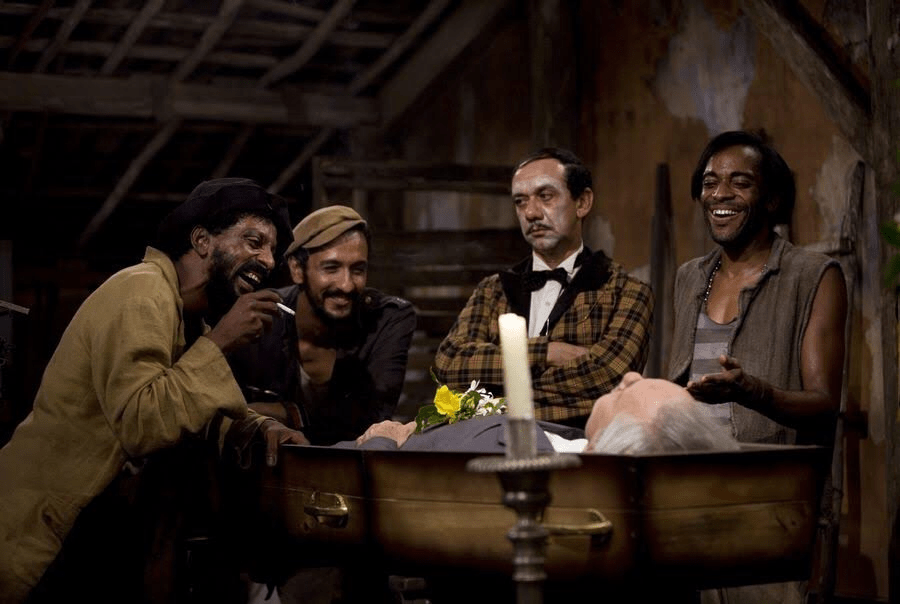
In Amado’s The Two Deaths of Quincas Water-Brey (A Morte e a Morte de Quincas Berro D’Agua) traversing class divides is the only remedy from monotonous ennui that afflicts a tenured civil servant Joaquim Soares da Cunha who, one fateful day, takes a tired glance at his wife and daughter, calls the both of them “vipers,” and departs, forever bolting up the door to his middle-class comforts, choosing instead the moist embraces of Salvador slums and a crown of “patriarch of prostitutes.” A few deliciously bohemian years later, Quincas (da Cunha’s slum nickname) dies, his weathered body submitted to intrusive and outrageously disrespectful post-mortem grooming by a great number of nasty relatives, all too eager to whitewash Quincas’ scandalizing, “family-shaming” metamorphosis. They dress him in a suit and put him and his respectable casket under surveillance, and all goes toward a perfectly boring bourgeois funeral. Thankfully, the gods of slums are not without mercy and send a throng of vagabonds to “rescue” Quincas’ body (no underwear but nice shoes!) and to give him his last legendary romp around town. Alcohol flows, fish stew in clay pots gives off fragrant fumes, bosoms tremble, arses shake, and Quincas, more alive than dead now, dances toward the sea, for he is “an old sailor without a sea and without a ship, corrupted on land but through no fault of his own.” Taking the last few thirsty gulps of cachaça, he submits his body to the sacred sea, the nurturing sea, the all-forgiving sea, as his fun-loving friends wave goodbye and return, once again, to their epicurean routines.

In a few dozen free-flowing pages of this novelette, Amado gives us, first of all, loads of saucy Rabelaisian fun as well as a lighthearted commentary on complex social structures and the nerve it takes to put a lid on the smouldering cauldron of etiquette micro-dramas, ties, suits, briefcases, and other nonsense. The resurrection of vagabond Quincas can also be read in a Jungian manner, as a ritual nod to the likes of Osiris, Dionysus, and other historical archetypes resonating with the collective unconscious. Quincas, after all, dies more than once, first as a civil servant, then as a vagabond, only to be resurrected, in both instances, by those who wish to place him squarely within the social class shelf they alone see fit for him to occupy. Quincas’ tango with death is his resounding refusal to be caught, to be classified or labeled, a fate, in his eyes, worse than ignoble oblivion.

The story of Quincas Water-Brey is but one of Amado’s many literary gifts to his motherland. Written throughout many decades and touching upon a plethora of subjects, they all nevertheless unite in an abundant wreath that celebrates, above all, joy, beauty, and optimism throbbing at the core of a complicated country.

Image: A still from the film Quincas Berro d’Agua (2010)

Mesa Selimovic’s Death and the Dervish: everyman’s ethical seppuku

Mesa Selimovic’s Death and the Dervish: everyman’s ethical seppuku

Mesa Selimovic intended his Death and the Dervish to be a commentary on faint-heartedness and moral cowardice that pervaded many aspects of life in communist Yugoslavia. Conveying this mood of metaphysical disenchantment, as all comforting notions of love, life, family, and country implode upon themselves to reveal nothing but punctured, hypocritical hollowness, Selimovic gives us Modernity, disguised in the shroud of 18th century Bosnia. It was a place technically within the coordinates of Ottoman splendour, and yet the most enduring cultural signal is not the aesthetics, the riches, or the intellectual rigour, but stifling corruption, abuse of power, violence, injustice, and countless other symptoms of an expansive empire feeling the burden of its own weight.

Perched atop this Babel there sits a Dervish. A man of faith. A man of doubt. One day, his brother disappears, and that’s when things start to get interesting, that’s when the masks drop and the prayer beads snap, and the Koran starts getting misquoted.

The Dervish Sheikh Nuruddin… His soul’s journey, documented before us in extremely quotable meditative plainchant, makes for a rather relatable, pitiable, sometimes admirable Everyman. Armed with Koran and ascetic rules of monastic life, he tiptoes along the labyrinth of society’s impossible choices, doubt cementing on his tired shoulders with each passing day. This doubt permeates every filament of human activity, its molecules invading everything from public spaces where political farce plays out with a hefty doze of injustice, down to the private nooks of people’s bedchambers, where one cannot be sure of one’s beloved’s fidelity. Everything melts, like Dali’s clocks, and the centre doesn’t  hold:

“We haven’t conquered the earth, but only a clot to put our feet on; we haven’t conquered mountains, but only their image in our eyes; we haven’t conquered the sea, but only its resilient firmness and the reflection of its surface. Nothing is ours but illusion, and therefore we hold onto it firmly. We’re not something in the world, but nothing in it; we’re not equal to what’s around us, but different, incompatible with it. In his development, man should strive for the loss of his self-consciousness. The earth is uninhabitable, like the moon, and we only delude ourselves thinking that it’s our true home, since we have no other place to go.”

Order, law, family, friendship, faith, all this, our Dervish discovers, is just victim to a “false conviction that we can keep life under control. But life keeps slipping away, and the more we try to keep hold of it, the more it eludes us.” Is it possible to accept this as a stone-cold fact and just move on? “How can a man live without beliefs that grow on him like skin, that become inseparable from him? How can you live without your self?”

This novel is chock-full of good existential questions like that, enough for a number of undergraduate philosophy classes to unpack. There are answers also, but more often unsatisfactory and nihilistic at best, once again underscoring the perpetual angst of a mind hard at work, digesting the cacophony of everyday chaos. Therein lies the timeless relevance of this work in our equally chaotic 21st century context. For instance:

“We should kill our pasts with each passing day. Blot them out, so that they will not hurt. Each present day could thus be endured more easily, it would not be measured against what no longer exists. As things are, spectres mix with our lives so that there is neither pure memory nor pure life. They clash and try to strangle each other, continually.”

Or this one:

“We vacillate between despair and the wish for peace and don’t know what is ours. It’s difficult to stop at either end, to embrace only one side, but that’s what we need to do. Any decision, except the one that will disturb our conscience, is better than the sense of disorientation with which indecision bestows us.”

The dervish is a spiritual Everyman, a stand-in for all of us, reasonably self-aware and yet not even remotely close to that coveted “inner peace.” He gives us plenty of stuff to work with: some are no more than elegant sound-bites, many are indistinguishable from modern-day self-help mindfulness vogue, and yet toward the end all of these noble aspirations, all this soul-searching and David vs Goliath heroism, all is lost in the vortex of self-destruction:

“Fear is flooding over me, like water. The living know nothing. Teach me, dead ones, how to die without fear, or at least without horror. Because death is senseless, as is life.”

Image: The Seated Demon, by Mikhail Vrubel

Anna Gavalda’s French Leave: Childhood’s very final (and very fun) hurrah

Anna Gavalda’s French Leave: Childhood’s very final (and very fun) hurrah

Some families are enviably idyllic. They traverse, like great big sail ships of old, through azure treachery of life’s turbulent waters, and no Pacific mega-storm or some ghastly kraken could break up the merriment on deck.

Gavalda gives us such a family in her 2011 novel French Leave. Four siblings, four nodes of a single pulsating system, each with their own prosaic cross to bear as they go forth adulting in life. And yet, in spite of the distance and the in-laws and the brutality of comfortable middle-class ignorance, these siblings, these saplings of a very cherishing earth, keep the gentle strings that maintain the delicate ecosystem of their connection in perfect balance.

They find their sanctuary, this joyful quartet, in a picturesque French countryside, with a chateau, wine, and music, an endless mixtape of carefully curated gems, each a token from not-so-distant past, the before-parents-divorced past, the before-the-gadgets past, complete with outdoor fun and scraped knees and crazy fun games. This is a lovely eulogy to Childhood, a sacrosanct interval on life’s measuring tape, and no amount of fussy sisters-in-law can commandeer it.

We don’t always burst with love for our siblings, but if we do it probably should be done like Gavalda’s four witty thirtysomethings. How do adults retain that level of effortless panache? That perfectly executed series of witty repartee? That intuitive, worldless understanding of the other heart’s rhythm? Is this even normal? Is this even real? Maybe distance, geographic and temporal, jump-starts the soul to its optimal performance level? How’s this, from the mouth of the youngest sibling (and our narrator):

“A huge wave of tenderness washed over me looking at the three of them: somehow this felt like the last magic show, the last birthday party of our childhood…

For almost thirty years they’d been making my life a place of beauty. What would I become without them? When would life decide it was time for us to part?

For that’s the way it goes. For time parts those who love one another, and nothing lasts.”

A gentle, silver-webbed kind of melancholy pierces this moment of universal experience. Who are we without our dear ones, those chance witnesses of our brief pilgrimage through life with all those monotone photocopier struggles and grocery store runs and weddings and divorces and the occasional sneaky cigarette. They liberate us, our dear ones, just as Adulthood pins us, like butterflies, to its collection board.

“For how much longer will we have the strength to tear ourselves away from everyday life and resist? How often will life give us the chance to play hooky? When will we lose one another, and in what way will the ties be stretched beyond repair? How much longer until we become too old?”

In the world of this novel, the happy recess from Adulthood comes to an end, waving goodbye to old castles and cassette tapes. This is all too neat, too careful, like a polite curtsy at the end of some country dance. For what would happen if this amusing recess were to turn into a whole lot of skipped classes for the rest of the afternoon..? Pearls never lie on the seashore.

Frederic Beigbeder and the decadent ennui of the upper-middle

Frederic Beigbeder and the decadent ennui of the upper-middle

Time cynically melts us all into oatmeal-variety curmudgeons… When I first familiarized myself with Beigbeder’s eloquent prose I was but a wee lass, deep in the throes of undergraduate know-thyselfing. A French Novel and Windows on the World had enthralled me by their world of nonchalant elegance and existential masturbation, carried on the sleek back of comfortably high Parisian incomes. Wide-eyed working-class Cinderellas always long to hatch into twenty-first-century Marie Antoinettes, toying with theatrical suicides as they soak up boredom and prosecco in a bath filled with diamonds and euros.

That was then and this is now. Beigbeder’s world still ravishes the reader’s senses, but whether it’s due to the throbbing waves of geopolitical metamorphosis, or merely due to something as banal as aging, my awe over his characters has withered into a very maternal sort of pity with a pinch of proletarian disgust.

Beigbederian hero, who is he? Young. Wealthy. Smart. Addicted to drugs, alcohol, sex, and partying. Adorably self-aware, self-hating and, to complete the initial data set, hopelessly narcissistic. He is a contemporary Nero longing for a return to childlike innocence as he parties his way toward a spiritual grave, wilfully mistaking its high-octane throbbing for the cavernous warmth of a womb. In Holiday in a Coma and Love Lasts Three Years, the hero is Marc Maronnier, a beautifully vapid butterfly, sadder than “a saucepan of milk boiling over,” a writer with a democratic libido (“some girls are so bovine they make you feel like a country vet…but I have to keep going”), and an eager documentarian of Parisian party scene with self-awareness of his privilege gnawing at him like an ulcer:

“Never has he been more forcefully aware of his standing as a snot-nosed brat from a good family than now, as he shakes his thang across the white marble floor, dreaming of being a rebel when in fact he is one of the landed gentry, alone in the midst of a herd of jaded ravers with no valid excuse while millions of the homeless sleep on scraps of torn cardboard when it’s -15 outside. He knows all of these things, which is why he hangs his head.” 

This is before the gilets jaunes and even before the Occupy movement, yet one can already smell the gunpowder of class friction, a scent far more potent than others emanating from Parisian nightclub loos Marc frequents (to amplify the metaphor, the nightclub in question is called Shit and is actually shaped like a massive toilet bowl). It is a miasma of glorious decay of Western masculinity, of euro-optimism, of bourgeois smugness, of cosmopolitan decadence. Like a Salvador Dali painting, the contours of past virtues are irreparably skewed. This is Peak Chaos, an infernal cauldron in which all these people with very classically First World problems simmer into a delectably poisonous stew.

And yet, it’s always most dark before dawn, isn’t it? Cynic he may be, but our privileged hero leaves us with the following axiom: “The most wonderful thing about life is that it goes on.” A couple hundred pages of entertaining mental masochism kamikaze themselves into a rather normal, even optimistic, finale. I’m not buying it though. By my reckoning, every Beigbeder ages into an Houllebecq, and there’s no stopping it.

Image: A Man Staring by Egon Schiele.